

AI Praxis Guide
Know What's Safe to Automate Before You Hand Over the Keys
A plain-English guide for non-technical owners: which workflows are safe to pilot, how OpenClaw and Hermes Agent actually compare for your business, and a 30-day plan to start small without risking customer data.
Every AI newsletter is selling you agents. None of them tell you what's actually safe to automate in a real business with real customers. This guide does. It's written for the owner who already uses AI but stalls at the same question: what can I let it handle, and what should never run without me watching? Start there. Decide with confidence.
- 100+ pages
- 10 chapters
- 8 bonus tools
- 30-day guarantee
- Zero code
Problem / Validation
Why this matters
You use AI most days. You've watched the demos, read the threads, maybe tried a tool or two. And you still feel a step behind, not because you're not capable, but because every source points somewhere different and none of them run your business.
The noise isn't the real problem. The real problem is the decision underneath it. When you picture an agent in your actual work, the questions get specific fast: your inbox, your customer data, your scheduling, your follow-ups. Do you use AI on our data? Is our information used for training? Those are the questions your customers will ask you, and right now you don't have a clean answer.
So you wait. Understandable. But waiting has a cost too. The repetitive work still eats your week. The competitor down the street starts piloting something and you're left guessing whether they know something you don't. And the longer "I'll figure out AI agents later" sits on the list, the bigger and vaguer it gets.
Here's the part most guides skip: the goal was never to automate everything. The businesses getting this right let agents draft, summarize, and prepare, and keep a human on anything that sends, charges, or speaks to a customer. You can move without betting the business, and without losing the personal relationships that make customers choose you in the first place. You just need to know where that line is.
Promise
What you will be able to do
Read it at your own pace over 7 to 14 days. By the end you'll be able to explain what an AI agent actually is, in plain language, without buzzwords. You'll know, workflow by workflow, what to trust, what to test, and what to leave alone. You'll be able to weigh OpenClaw against Hermes Agent as a business decision instead of an engineering project. And you'll finish with your own Agent Readiness Map and a 30-day pilot plan you can start the same week, built around approval boundaries that keep customer data and customer trust protected.
No code. No API setup. No promise that agents will replace anyone.
Why this guide exists: It was written because the available material splits into two unhelpful piles: technical tutorials for people who build agents, and hype pieces for people who sell them. Nothing sat in the middle for the owner who has to decide. This guide is that missing middle: a decision framework first, a tool comparison second, and a careful pilot plan third.
What's Inside
What is inside
The core guide — 10 chapters, 100+ pages, plain English:
8 bonus tools — the worksheets that turn the reading into decisions:
Chapter 1: What AI Agents Actually Are
A definition that sticks, with no jargon and no hype. You'll be able to explain it to your team by the end of the chapter.
Chapter 2: Why Small Businesses Are Interested
The real, grounded reasons owners are paying attention now, and an honest take on the barriers (it's lack of clarity, not lack of nerve).
Chapter 3: What Agents Should Not Touch Yet
The red lines. Payments, refunds, legal calls, unsupervised customer messages, irreversible data changes. Where automation does more harm than good.
Chapter 4: The Agent Readiness Map
Score any workflow on three things: data sensitivity, decision type, and business impact. This is the tool you'll use to decide everything else.
Chapter 5: OpenClaw in Plain English
What it is, what it's built for, when an owner like you would reach for it, and where its limits are. A case study, not a sales pitch.
Chapter 6: Hermes Agent in Plain English
The same even-handed treatment. How it works, when you'd choose it, and the tradeoffs to weigh.
Chapter 7: OpenClaw vs Hermes Agent — Which Kind of Owner Are You?
A neutral, side-by-side comparison framed around your situation, not a winner. Control-first or convenience-first: the answer depends on you.
Chapter 8: The First Five Safe Business Agents
Five low-risk workflows owners are already running: inbox triage drafts, weekly reporting drafts, FAQ and support reply drafts, meeting notes to action items, and customer intake prep. Draft and prepare only — nothing sends on its own.
Chapter 9: Approval Boundaries and Safety Rules
How to set guardrails so an agent helps without surprising you. What to review, how often to check, and how to answer your customers' data questions honestly.
Chapter 10: Your 30-Day Agent Adoption Plan
Week by week: set up, observe, expand carefully, audit, then decide. A reversible first win before you trust anything bigger.
Agent Readiness Worksheet
The one-page self-assessment from Chapter 4. Score data sensitivity, decision autonomy, and impact, and see where a workflow lands before you touch it.
OpenClaw vs. Hermes Decision Matrix
Chapter 7's decision matrix in one page. Score the five dimensions of owner fit, see which owner archetype you are, and pick a primary option with a written reason you can defend.
Who This Is For
Who this is for
The owner who's past "what is ChatGPT?"
You use AI already. You're not asking what it is. You're asking what you can safely let it do, on your own data, in your own business.
The 2-to-50-person business without a CTO
No engineering team, no time for whitepapers. You need plain language and a clear next step, not architecture diagrams.
The owner of customer-facing work
Service, scheduling, intake, follow-up, data entry. You've considered automating it and stopped at the thought of an agent emailing a customer something wrong.
The "maybe a pilot" owner
You're not trying to replace anyone. You want to know if an agent can take the repetitive, low-stakes work off your plate so your team can do the work that needs a human.
Who This Is NOT For
Who this is not for
This isn't a coding tutorial or a guide to building your own agents. If your goal is to write the software yourself, you'll want more technical depth than this gives you. It's also not a promise that agents will run your business or replace your people. They can't, and anyone selling you that is selling hype. Treat this as the careful first step in deciding what to trust, what to test, and what to leave alone. That's exactly what it's built to be.
30-Day "No Questions Asked" Money-Back Guarantee
Read the whole guide. Fill in the Readiness Worksheet. Run the flowchart against your real workflows. If it doesn't give you a clearer, more confident answer about what to automate and what to leave alone, email us within 30 days and we'll refund every penny. No forms, no back-and-forth. The risk is ours, which is how it should be when you haven't seen the inside yet.
Pricing & Purchase
One Clear Decision, for the Price of an Hour You'd Waste Guessing
$49 launch price (compare at $79) Instant digital download. A 100+ page PDF that reads on any device, with no expiration.
A single hour with an AI consultant costs more than this entire guide, and it won't leave you with a reusable framework or a worksheet your team can run on their own. This is the version you keep.
You already feel the pull to do something with AI, and the hesitation about doing the wrong thing. Both are right. This guide doesn't ask you to ignore the caution. It gives the caution a structure, so you can move on the safe workflows and confidently leave the risky ones alone. Pour an hour into reading it and you'll trade a vague "I should look into agents" for a specific, written plan you can start this week.
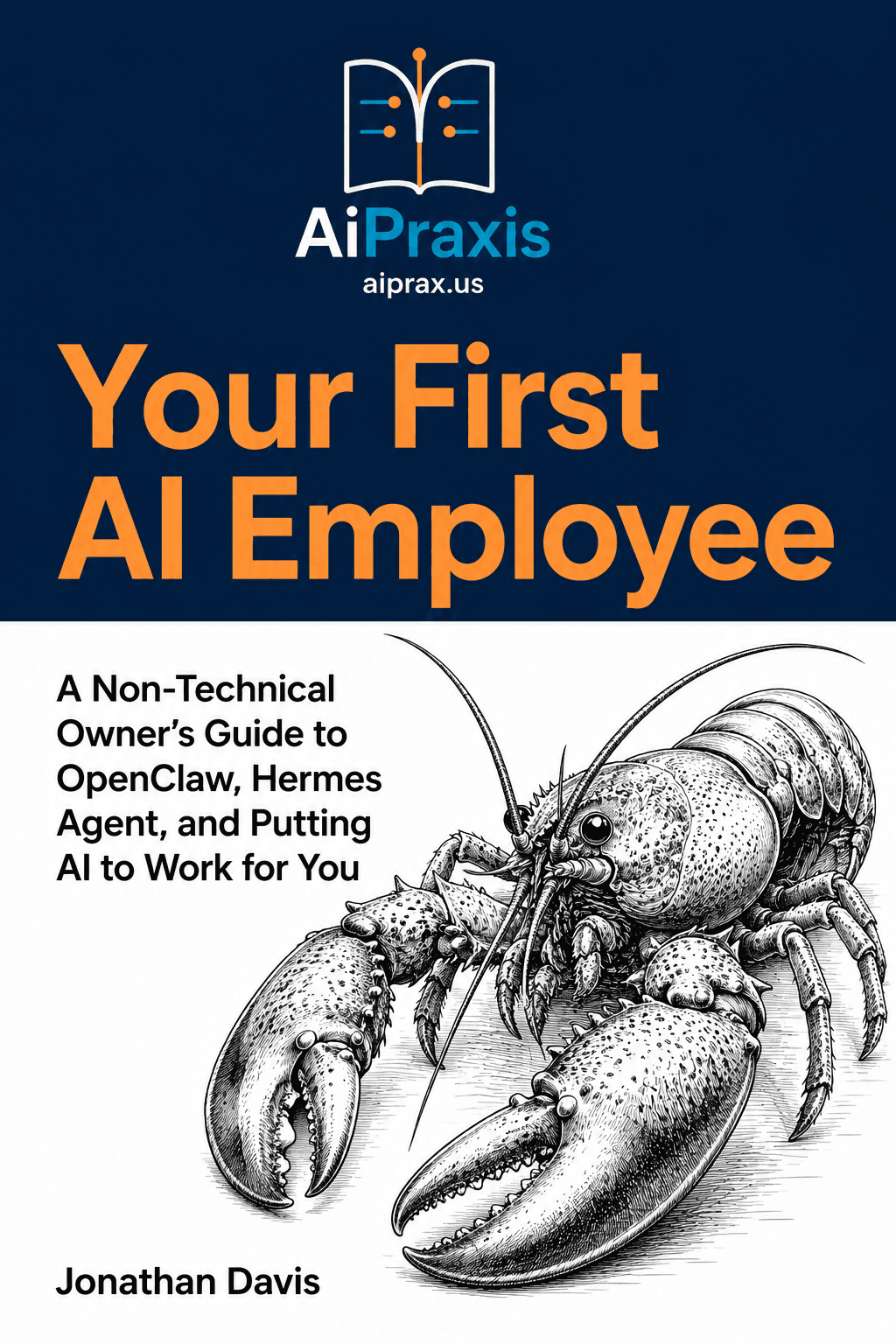
Your First AI Employee
Digital PDF (instant download)
- The 100+ page core guide — all 10 chapters
- 8 bonus worksheets, checklists, and templates
- The detailed, day-by-day 30-day pilot plan
- The Agent Readiness Map and OpenClaw vs. Hermes Decision Matrix
- Free updates as the tools and the guidance evolve
Secure checkout via Square. One-time payment — no subscription. Download access appears immediately after purchase.
Free preview
Not Sure Yet? Read Chapter 1 Free.
Enter your email and we'll send you the first chapter: the plain-English definition of what an AI agent actually is, and the readiness question every owner should answer before automating anything. No payment, no pressure. If it's the calm, specific guide you've been looking for, the rest is one click away. If not, you've lost nothing.
Questions & Answers
Everything you need to know before you decide
Still have a question? Email us anytime — we personally read every message.
No. It's written for owners and operators, with zero code and zero API setup. OpenClaw and Hermes are explained in plain English: how they work, what they cost, when you'd pick each, so you can decide without becoming an engineer. If something needs coding to follow, it's not in this book.